by Benoit Mandelbrot
Geographical curves are so involved in their detail that their lengths are often infinite or, rather, undefinable. However, many are statistically 'self-similar,' meaning that each portion can be considered a reduced-scale image of the whole.
tags: Mandelbrot, Fractals, Geographical, paper
Geographical curves are so involved in their detail that their lengths are often infinite or, rather, undefinable. However, many are statistically "self-similar," meaning that each portion can be considered a reduced-scale image of the whole. In that case, the degree of complication can be described by a quantity D that has many properties of a "dimension," though it is fractional; that is, it exceeds the value unity associated with the ordinary, rectifiable, curves.
Seacoast shapes are examples of highly involved curves such that each of their portions can - in a statistical sense - be considered a reduced-scale image of the whole. This property will be referred to as "statistical self-similarity."
To speak of a length for such figures is usually meaningless. Similarly, "the left bank of the Vistula, when measured with increased precision, would furnish lengths ten, hundred or even thousand times as great as the length read off the school map." More generally, geographical curves can be considered as superpositions of features of widely scattered characteristic size; as ever finer features are taken account of, the measured total length increases, and there is usually no clearcut gap between the realm of geography and details with which geography need not be concerned.
Quantities other than length are thus needed to discriminate between various degrees of complication for a geographical curve. When a curve is self-similar, it is characterized by an exponent of similarity, D, which possesses many properties of a dimension, though it is usually a fraction greater than the dimension 1 commonly attributed to curves. We shall reexamine in this light some empirical observations by Richardson. I propose to interpret them as implying, for example, that the dimension of the west coast of Great Britain is D = 1.25. Thus, the so far esoteric concept of "random figure of fractional dimension" is shown to have simple and concrete applications and great usefulness.
Self-similarity methods are a potent tool in the study of chance phenomena, including geostatistics, as well as economics and physics. In fact, many noises have dimensions D contained between 0 and 1, so that the scientist ought to consider dimension as a continuous quantity ranging from 0 to infinity.
Measuring the Length of a Coast
Returning to the claim made in the first paragraph, let us review the methods used when attempting to measure the length of a seacoast. Since a geographer is unconcerned with minute details, he may choose a positive scale G as a lower limit to the length of geographically meaningful features. Then, to evaluate the length of a coast between two of its points A and B, he may draw the shortest inland curve joining A and B while staying within a distance G of the sea. Alternatively, he may draw the shortest line made of straight segments of length at most G, whose vertices are points of the coast which include A and B.
In practice, measurements are made by walking a pair of dividers along a map so as to count the number of equal sides of length G of an open polygon whose corners lie on the curve. If G is small enough, it does not matter whether one starts from A or B. Thus one obtains an estimate of the length to be called L(G).
Unfortunately, geographers will disagree about the value of G, while L(G) depends greatly upon G. Consequently, it is necessary to know L(G) for several values of G. Better still, it would be nice to have an analytic formula linking L(G) with G. Such a formula, of an entirely empirical character, was proposed by Lewis F. Richardson but unfortunately it attracted no attention. The formula is:
L(G) = M G^(1−D)
where M is a positive constant and D is a constant at least equal to unity. This D, a "characteristic of a frontier," may be expected to have some positive correlation with one's immediate visual perception of the irregularity of the frontier.
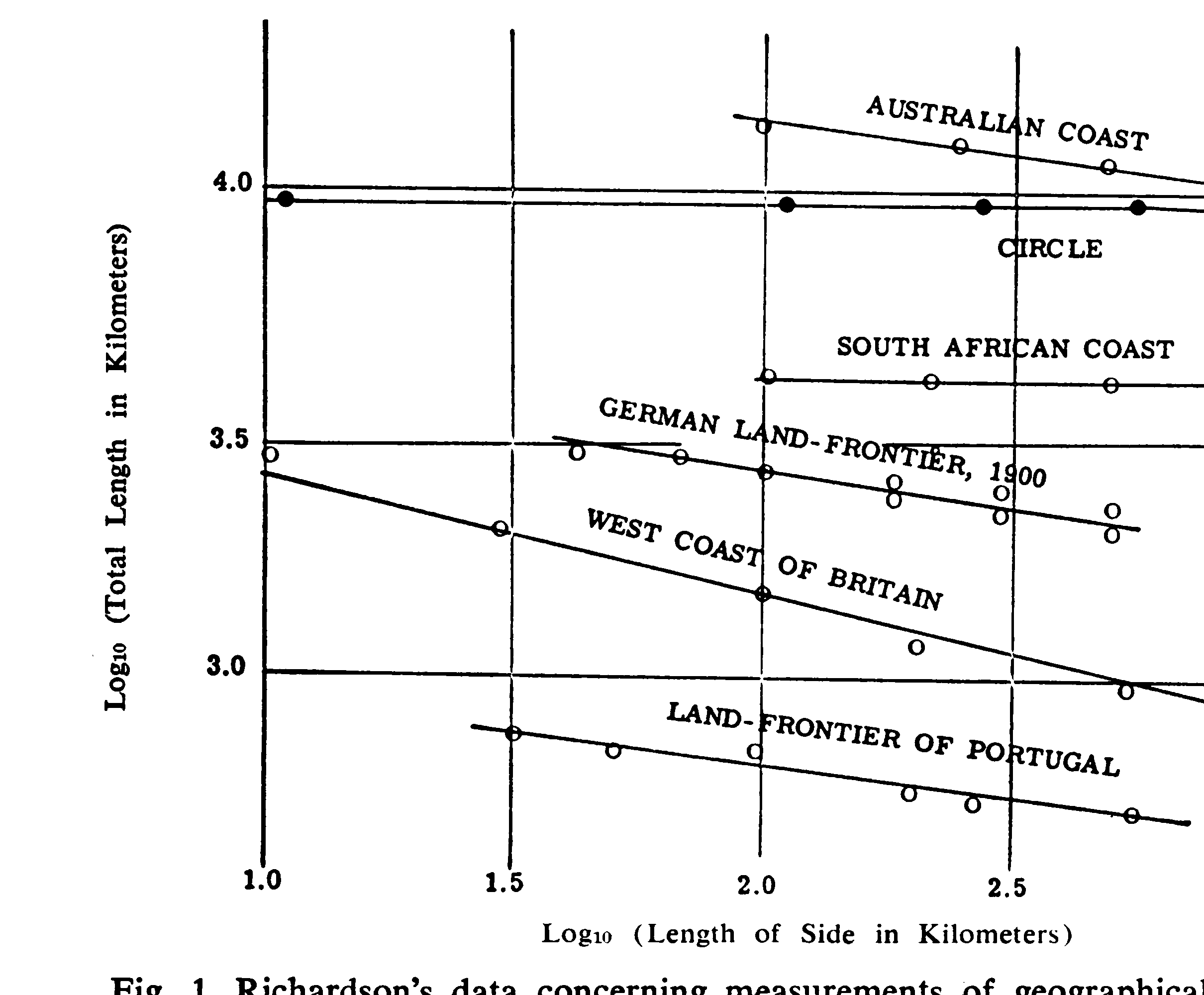
Examples:
- At one extreme, D = 1.00 for a frontier that looks straight on the map.
- For the other extreme, the west coast of Britain was selected because it looks like one of the most irregular in the world; it was found to give D = 1.25.
- Three other frontiers gave D = 1.15 for the land frontier of Germany in about A.D. 1899; D = 1.14 for the land frontier between Spain and Portugal; and D = 1.13 for the Australian coast.
- A coast selected as looking one of the smoothest in the atlas was that of South Africa, and for it D = 1.02.
Richardson's empirical finding is in marked contrast with the ordinary behavior of smooth curves, which are endowed with a well-defined length and are said to be "rectifiable." To quote Steinhaus again: "a statement nearly adequate to reality would be to call most arcs encountered in nature not rectifiable. This statement is contrary to the belief that not rectifiable arcs are an invention of mathematicians and that natural arcs are rectifiable: it is the opposite that is true."
Fractional Dimension and Self-Similarity
I interpret Richardson's relation as contrary to the belief that curves of dimension greater than one are an invention of mathematicians. For that, it is necessary to review an elementary feature of the concept of dimension and to show how it naturally leads to the consideration of fractional dimensions.
To begin, a straight line has dimension one. Hence, for every positive integer N, the segment (0 ≤ x < X) can be exactly decomposed into N non-overlapping segments, each deducible from the whole by a similarity of ratio r(N) = 1/N. Similarly, a plane has dimension two. More generally, the dimension D is characterized by the relation:
D = −log N / log r(N)
This last property means that D can also be evaluated for more general figures that can be exactly decomposed into N parts such that each is deducible from the whole by a similarity of ratio r(N), or perhaps by a similarity followed by rotation and even symmetry. To show that such figures exist, it suffices to exhibit a few obvious variants of von Koch's continuous non-differentiable curve.
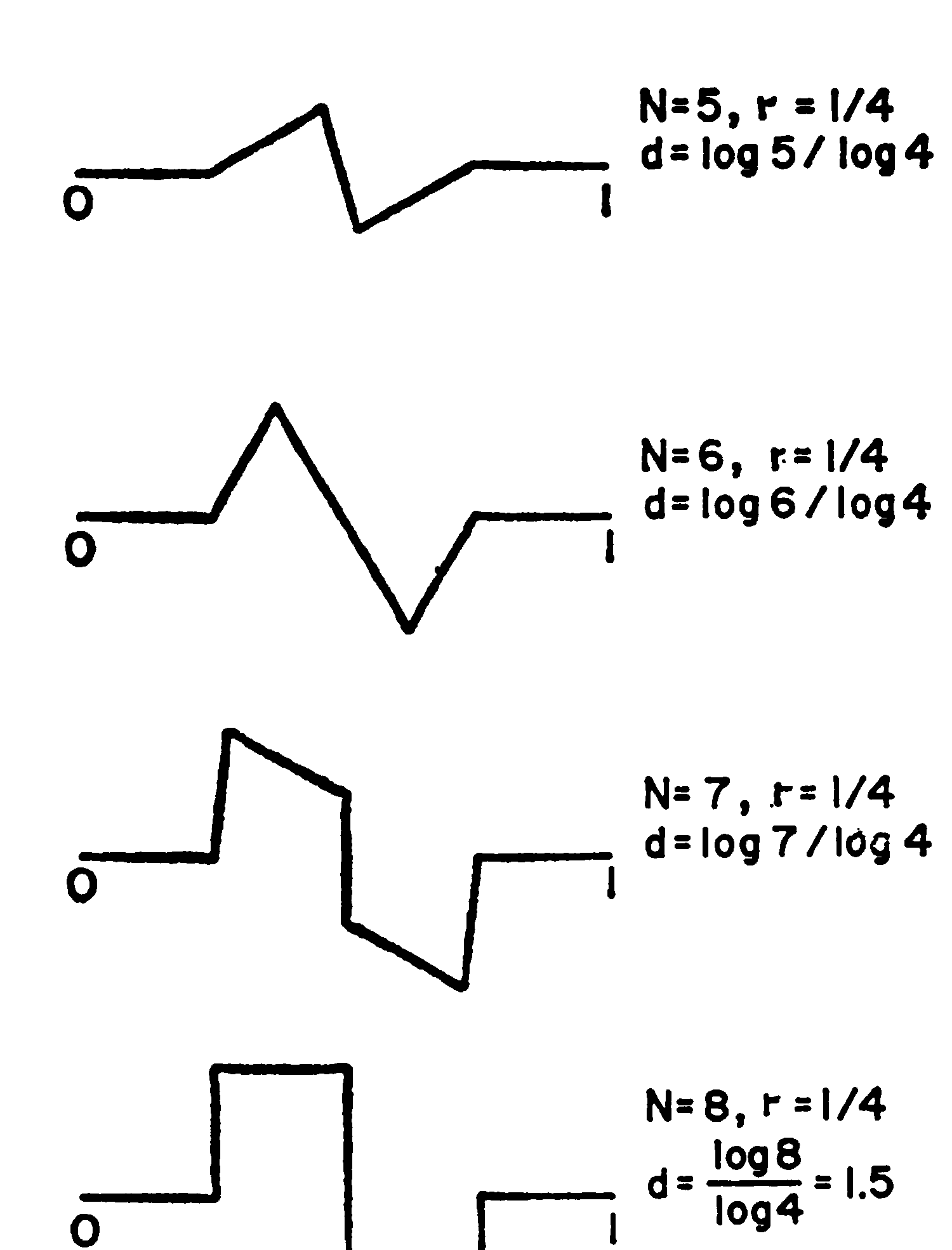
Each of these curves is constructed as a limit. At step number s, the approximation is made of N^s segments of length G = (1/4)^s, so that L = (N/4)^s = G^(1−D). Thus, the length of the limit curve is infinite, even though it is a "line."
Practical application of this notion of dimension requires further consideration, because self-similar figures are seldom encountered in nature (crystals are one exception). However, a statistical form of self-similarity is often encountered, and the concept of dimension may be further generalized.
Under wide conditions, the length of approximating polygons will asymptotically behave like L(G) ∝ G^(1−D).
To specify the mathematical conditions for the existence of a similarity dimension is not a fully solved problem. In fact, even the idea that a geographical curve is random raises a number of conceptual problems familiar in other applications of randomness. Therefore, to return to Richardson's empirical law, the most that can be said with perfect safety is that it is compatible with the idea that geographical curves are random self-similar figures of fractional dimension D. Empirical scientists having to be content with less than perfect inductions, I favor the more positive interpretation stated at the beginning of this report.
Benoit Mandelbrot, International Business Machines, Thomas J. Watson Research Center, Yorktown Heights, New York. Received 14 November 1966; accepted 27 March 1967. Science, Vol. 156, 5 May 1967.
References and Notes
- H. Steinhaus, Colloquium Mathematicum 3, 1 (1954), where earlier references are listed.
- L. F. Richardson, in General Systems Yearbook 6, 139 (1961).
- B. Mandelbrot, J. Business 36, 394 (1963); or in The Random Character of Stock Market Prices, P. H. Cootner, Ed. (M.I.T. Press, Cambridge, Mass., 1964), p. 297.
- B. Mandelbrot, IEEE Trans. Commun. Technol. 13, 71 (1965) and IEEE Trans. Inform. Theory 13 (1967). Very similar considerations apply in turbulence, where the characteristic sizes of the "features" (that is, the eddies) are also very widely scattered, as was first pointed out by Richardson himself in the 1920's.
- The concept of "dimension" is elusive and very complex, and is far from exhausted by the simple considerations of the kind used in this paper. Different definitions frequently yield different results, and the field abounds in paradoxes. However, the Hausdorff-Besicovitch dimension and the capacitary dimension, when computed for random self-similar figures, have so far yielded the same value as the similarity dimension.