by Douglas R. Hofstadter
Analogy is anything but a bitty blip - rather, it's the very blue that fills the whole sky of cognition.
tags: Hofstadter, analogy, cognition, language, chunking, perception, translation, Pushkin
Analogy is anything but a bitty blip - rather, it's the very blue that fills the whole sky of cognition - analogy is everything, or very nearly so.
From The Analogical Mind: Perspectives from Cognitive Science, MIT Press, 2001. Illustrations by Douglas R. Hofstadter.
One should not think of analogy-making as a special variety of reasoning (as in the dull and uninspiring phrase "analogical reasoning and problem-solving," a long-standing cliché in the cognitive-science world), for that is to do analogy a terrible disservice. After all, reasoning and problem-solving have (at least I dearly hope!) been at long last recognized as lying far indeed from the core of human thought. If analogy were merely a special variety of something that in itself lies way out on the peripheries, then it would be but an itty-bitty blip in the broad blue sky of cognition. To me, however, analogy is anything but a bitty blip - rather, it's the very blue that fills the whole sky of cognition - analogy is everything, or very nearly so, in my view.
The thrust of my chapter is to persuade readers of this unorthodox viewpoint, or failing that, at least to give them a strong whiff of it. In that sense, then, my article shares with Richard Dawkins's The Selfish Gene the quality of trying to make a scientific contribution mostly by suggesting to readers a shift of viewpoint. For Dawkins, the shift was to turn causality on its head, so that the old quip "a chicken is an egg's way of making another egg" might be taken not as a joke but quite seriously. In my case, the shift is to suggest that every concept we have is essentially nothing but a tightly packaged bundle of analogies.
Two Riddles
We begin with a couple of simple queries about familiar phenomena: "Why do babies not remember events that happen to them?" and "Why does each new year seem to pass faster than the one before?"
The answer to both is basically the same, I would argue, and it has to do with the relentless, lifelong process of chunking - taking "small" concepts and putting them together into bigger and bigger ones, thus recursively building up a giant repertoire of concepts in the mind.
Babies' concepts are simply too small. They have no way of framing entire events whatsoever in terms of their novice concepts. It is as if babies were looking at life through a randomly drifting keyhole, and at each moment could make out only the most local aspects of scenes before them. Or, to trot out another analogy, life is like a chess game, and babies are like beginners looking at a complex scene on a board, not having the faintest idea how to organize it into higher-level structures. Experienced chess players chunk the setup of pieces on the board nearly instantaneously into small dynamic groupings defined by their strategic meanings, and thanks to this automatic, intuitive chunking, they can make good moves nearly instantaneously and also can remember complex chess situations for very long times.
As one grows older, one's chunks grow in size and in number, and consequently one automatically starts to perceive and to frame ever larger events. Events that a baby or young child could not have possibly perceived as such are effortlessly perceived and stored away as single structures.
As for the second riddle: the more we live, the larger our repertoire of concepts becomes, which allows us to gobble up ever larger coherent stretches of life in single mental chunks. As we start seeing life's patterns on higher and higher levels, the lower levels nearly vanish from our perception. Seconds, once so salient to our baby selves, nearly vanish from sight, and then minutes go the way of seconds, and soon so do hours, and then days, and then weeks.
Analogy, Abstract Categories, and High-Level Perception
Before I go any further, I would like to relate all this to analogy, for to some the connection may seem tenuous, if not nonexistent. I begin with the mundane observation that vision takes an input of millions of retinal dots and gives an output of concepts - often words or phrases, such as "duck," "Victorian house," "funky chair," or "Joyce Carol Oates hairdo."
The (visual) perceptual process can be thought of as the triggering of mental categories by scenes. Of course, high-level perception can take place through other sensory modalities: we can hear a low rumbling noise and say "helicopter," can sniff something and remark "doctor's office," can taste something and find the words "okra curry" jumping to our tongue.
In fact, I should stress that the upper echelons of high-level perception totally transcend the normal flavor of the word "perception." Suppose I read a newspaper article about the violent expulsion of one group of people by another group from some geographical region, and the phrase "ethnic cleansing," nowhere present in the article, pops into my head. What has happened here is a quintessential example of high-level perception - but what was the input medium? Someone might say it was vision, since I used my eyes to read the newspaper. But really, was I perceiving ethnic cleansing visually? Hardly.
The Mental Lexicon: A Vast Storehouse of Triggerable Analogies
We humans begin life as rather austere analogy-makers - our set of categories is terribly sparse, and each category itself is hardly well-honed. Categories grow sharper and sharper and ever more flexible and subtle as we age, and of course fantastically more numerous. Many of our categories are named by words or standard phrases shared with other people - categories that are named by so-called lexical items. The public labels of such categories come in many grades:
Simple words: chair, clock, cork, cannon, crash, clown...
Compound words: armchair, alarm clock, corkscrew, cannonball, skyscraper, station wagon...
Short phrases: musical chairs, out of order, Christmas tree ornament, nonprofit organization, rush-hour traffic, country-Western music, welcome home...
Longer phrases: stranded on a desert island; damned if you do, damned if you don't; praise the Lord and pass the ammunition; not in the foreseeable future; and they lived happily ever after...
Such lists go on and on virtually forever, and yet the amazing fact is that few people have any inkling of the vastness of their mental lexicons. Most adults use their vast mental lexicons with great virtuosity, but they have stunningly little explicit awareness of what they are doing.
The Common Core Behind a Lexical Item
Things "out there" - objects, situations, whatever - that are labeled by the same lexical item have something, some core, in common. Getting to the core of things is, after all, what categories are for.
The noun "shadow" offers a good example of the complexity and subtlety of structure that lurks behind not just some lexical items, but behind every single one.
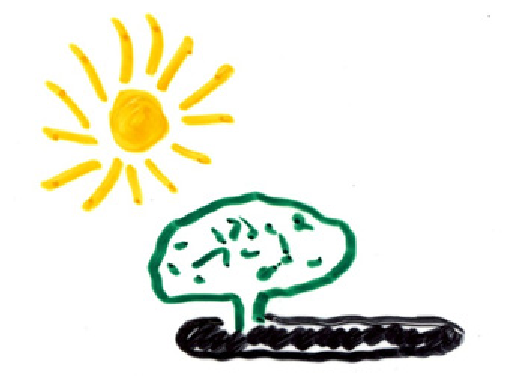
Note, first of all, the subtle difference between "shadow" and "shade": we do not speak of cattle seeking shadow on a hot day, but shade. Many languages do not make this distinction, and thus they offer their native speakers a set of categories that is tuned slightly differently.
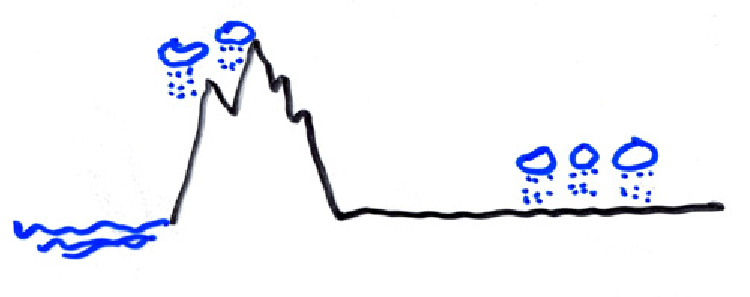
In many parts of the world, there are arid zones that lie just to the east of mountain ranges (e.g., the desert in Oregon just to the east of the Cascade mountains); these regions are standardly referred to as the mountain chain's "rain shadow."
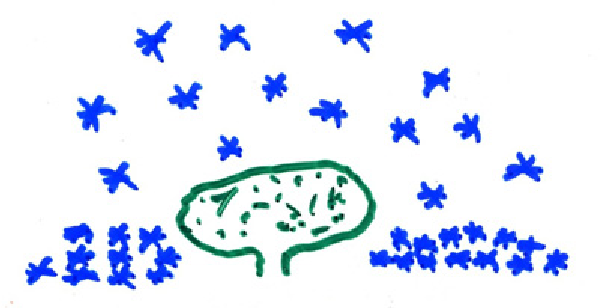
What does one call the roughly circular patch of green seen underneath a tree after a snowfall? It could clearly be called a "snow shadow" - the region where snow failed to fall, having been blocked by an object.
A young woman who aspires to join her high-school swimming team, but whose mother was an Olympic swimmer, can be said to be "in the shadow of her mother." One might say about a man who has had a bout with cancer but has recovered, "He is finally feeling more or less out of the shadow of his cancer." And there are population shadows cast by wars - regions of humanity where the flow of births has been greatly reduced long after the event, like a shadow that fades slowly.
Polysemy and the Nonspherical Shapes of Concepts
It would be naive to imagine that each lexical item defines a perfectly "spherical" region in conceptual space. A more accurate image of what lies behind a typical lexical item might be that of a molecule with two, three, or more nuclei that share an irregularly shaped electron cloud.
Often native speakers of a language have a hard time realizing that two notions labeled identically in their language are seen as highly distinct concepts by speakers of other languages. Thus, native speakers of English feel the verb "to know" as a monolithic concept, and are sometimes surprised to find out that in other languages, one verb is used for knowing facts, a different verb for knowing people, and there may even be a third verb for knowing how to do things.
The simplest concepts are like isolated islands in a sea; the next-simplest are like pairs of islands joined by a narrow isthmus; then there are trios with two or three isthmuses having various widths. The most frequently encountered concepts, whose elaborate ramifications and tendrils constitute the highest degree of twistiness, are the ones planted earliest in childhood.
Lexical Blends as a Window onto the Mind
Lexical blends, which are astonishingly common though very seldom noticed by speakers or listeners, reveal precisely the unconscious competition among close relatives in the mental lexicon. A lexical blend occurs when a situation evokes two or more lexical items at once and fragments of the various evoked competitors wind up getting magically, sometimes seamlessly, spliced together into the vocalized output stream.
Thus people make blends of the following sorts:
Word-level blends: mop/broom → brop
Phrase-level blends: easygoing/happy-go-lucky → easy-go-lucky
Sentence-level blends: "We'll leave no stone unturned" / "We'll pull out all the stops" → "We'll pull no stops unturned"
Blends reveal how much goes on beneath the surface as our brains try to figure out how to label simpler and more complex situations. What is amazing is that blends are not more common. Somehow, through some kind of cerebral magic, speakers light most of the time upon just one lexical label despite the existence of many potential ones - much as when a good pianist plays the piano, it is very seldom that two keys are struck at once, even though it might seem, a priori, that striking two neighboring keys at once ought to happen very often.
The Central Cognitive Loop
Abstract remindings - when a dormant memory surfaces unexpectedly because it structurally matches a current situation - have been noted here and there in the cognitive-science literature. It is my purpose to stake the claim that they are the starring role of cognition.
A long-term memory node is accessed, transferred to short-term memory and there unpacked to some degree, which yields new structures to be perceived, and the high-level perceptual act activates yet further nodes, which are then in turn accessed, transferred, unpacked, and so on. This is the central cognitive loop:
perception → activation → transfer → unpacking → re-perception → ...
Note that what I have described is not problem-solving, which has traditionally played such a large role in modelling of thought. No, everyday thought is not problem-solving or anything that resembles it at all; rather, it is a nonrandom stroll through long-term memory, mediated by high-level perception - which is simply another name for analogy-making.
Goal-Drivenness and the Sapir-Whorf Hypothesis
Where do goals enter this picture? Each person, as life progresses, develops a set of high-level concepts that they tend to favor, and their perception is continually seeking to cast the world in terms of those concepts. The avoidance of mental discomfort - the avoidance of cognitive dissonance - constitutes a powerful internal force that helps to channel the central loop in what amounts to a strongly goal-driven manner.
Consider such words as "backlog," "burnout," "micromanaging," and "underachiever," all of which are commonplace in today's America. We Americans living at the millennium's cusp perceive backlogs of all sorts permeating our lives - but we do so because the word is there, warmly inviting us to see them. But back in, say, Johann Sebastian Bach's day, were there backlogs - or more precisely, were backlogs perceived? For that matter, did Bach ever experience burnout? Well, most likely he did - but did he know that he did?
Transportation: Language as Analogy
The usual goal of communication is to set up "the same thought" in the receiver's brain as is currently taking place in the sender's brain. The mode by which such replication is attempted is essentially a drastic compression of the complex symbolic dance occurring in the sender's brain into a temporal chain of sounds or a string of visual signs - "powdered food for thought" - which are then absorbed by the receiver's brain, where, by "just adding water," a new symbolic dance is launched.
In his book The Poetics of Translation, poet Willis Barnstone points out that on the side of all Greek moving vans is written the word μεταφορά - phonetically "metafora" and semantically "transportation." Every motor truck hauling goods from one place to another, every perceived metamorphosis of a word or phrase within or between languages, every decipherment and interpretation of a text, leads us directly to the art and activity of translation.
Since translation is but the challenge of communication rendered crystal-clear, and since communication is but metaphor, and since metaphor is but analogy, translation is analogy at its most sublime and enchanting.
Eugene Onegin: Analogy in Verse
As a recent translator of Alexander Pushkin's novel in verse Eugene Onegin, I have been totally absorbed in the delicious but daunting task of reincarnating Pushkin's sparkling poetry in the medium of contemporary English.
Each "Onegin stanza" consists of fourteen lines of strict iambic tetrameter. The rhyming pattern is always:
A B A B C C D D E F F E G G
where A, C, and E line-pairs are feminine rhymes (nine syllables, unstressed final syllable), and B, D, F, G line-pairs are masculine rhymes (eight syllables, stressed final syllable). All four hundred sonnets in the original Russian have this property.
Under this constraint, a translator must simultaneously navigate four competing pressures:
- Content - the image evoked by the words
- Structural pattern - the formal phonetic constraints (meter, rhyme, syllable count)
- Tone - the intangible brew of humor, era, gravity, lightness
- Tonal equivalence - the feel of the specific register Pushkin employed
The amusing fact about the result of all these kinds of creative slippage is that what emerges can often be so powerfully evocative of the original that it seems perfectly plausible to refer to the English-language stanza thereby produced as being "by Alexander Pushkin."
Take, for instance, line 10 of the 29th stanza from Chapter II. Pushkin's image is of a father who, because he never read, simply didn't care what his daughter kept hidden beneath her pillow. Nabokov, ever the literalist, wrote simply: "nor did he care." Hofstadter wrote: "didn't give a tinker's damn" - a phrase Pushkin never used, yet which carries precisely the Pushkinesque lightness and colloquial humor the moment demands. By what right? The same right by which any analogy is made.
Winding Up: Associationism and the Cartesian Theater
This may sound like no more than the age-old idea of associationism - that we think by jumping associatively from one thing to another. But the mechanisms I posit are more specific, and in particular they depend on the transfer of tightly packed mental chunks from the dormant area of long-term memory into the active area of short-term memory, and on their being unpacked on arrival, and then scrutinized.
To those who would scoff at the very notion of any "inner screen" involved in cognition, I would point to the large body of work of perceptual psychologist Anne Treisman, which in my view establishes beyond any doubt the existence of temporary perceptual structures created on the fly in working memory - what she calls "object files."