-
BY OTHERS◆Monday, May 11, 2026
Sixty-three men and women in seven elements - polar explorers, single-handed sailors, desert wanderers, mail pilots, climbers, river-runners, travel-writers. The case against the comfortable life. 548 curated sayings across eight centuries, Rogerson's 524-quote commonplace book on travel (chapter accordion), two full books - Shackleton's South + Slocum's Sailing Alone.
tags: adventure, exploration, polar, antarctic, arctic, shackleton, scott, amundsen, lawrence of arabia, saint-exupery, slocum, nansen, mallory, bourdain, burton, chatwin, theroux, iyer, cook, lindbergh, hillary, tenzing, messner, harrer, livingstone, stanley, kingsley, bell, heyerdahl, basho, macfarlane, matthiessen, kapuscinski, blixen, muir, dalrymple, bligh, davidson, travel writers, courage, leadership, edwardian, expedition
∮ ∞ ∮
“Polar exploration is at once the cleanest and most isolated way of having a bad time which has been devised.”
- Apsley Cherry-Garrard, The Worst Journey in the World (1922)
This archive collects sixty-four lives that go together because they all involve the deliberate exchange of comfort for meaning. Not soldiers, who were ordered out; not athletes, who were paid. Civilians who looked at a map and saw a blank, or looked at a peak and saw a problem, and went anyway. Nine are polar; eight sailed; eight crossed the deserts; five flew; ten climbed; six ran rivers or jungles; and eighteen walked the long road and wrote the books that brought it back - Marco Polo and Ibn Battuta in the Middle Ages; Bashō in the seventeenth; Burton, Stark in the European century; Kapuściński, Theroux, Chatwin, Iyer, Murphy, Bourdain, Lezhava, Macfarlane, Matthiessen, Dalrymple in our own.
The point of grouping them is that none of them - Shackleton aside, perhaps Lawrence - is quite famous enough now to warrant a shelf of his own. But put them in one room and they become a case: that the comfortable life is not the only life, and that the men and women who refuse it leave behind a particular kind of writing - terse, observational, technical, occasionally biblical, almost never sentimental. The dispatch.
Seven elements, sixty-four voices, five hundred and forty-nine sayings. The page in order: the roll of voices (click Show all to unfold the seven elements) · a random dispatch you can keep drawing · Rogerson’s 524-quote commonplace book (chapter accordion) · Newby’s A Book of Travellers’ Tales - three hundred and eleven tales across eleven sections, with a clickable chart of ten geographic regions plus an Advice to Travellers preface · Theroux’s Tao of Travel - twenty-seven essays of his own around the writers who shaped him · Calvino’s 55 Invisible Cities · the gallery of dossiers · and two featured volumes - Shackleton’s South (1919) and Slocum’s Sailing Alone Around the World (1900), both in full.
Α. The Roll
- A ROLL OF EXPLORERS · 64 LIVES · 549 SAYINGS · SEVEN ELEMENTS -
The Adventurers
Being a roll of those who went out
Sixty-seven men and women who went out and came back changed - or in some cases, did not come back at all. Polar explorers, single-handed sailors, desert wanderers, mail pilots, climbers, river-runners, road-walkers. The case against the comfortable life.
“The dreamers of the day are dangerous men.”
- T. E. Lawrence, Seven Pillars of Wisdom (1926)
“Adventure is just bad planning.”
- Roald Amundsen, the first man to the South Pole, who planned for it for fifteen years.
Β. A Dispatch from the Field
A new saying loads each visit, drawn from any of the sixty-four. Filter by element, by voice, or search any phrase - try endurance, step, sea, dream, road, food, mountain.
DISPATCH · 549 SAYINGS · 64 VOICES
A Dispatch from the Field
One loads on each visit. Press ↻ DRAW for another. Filter by element, by voice, or search any phrase - try endurance, dream, sea, step.
ELEMENT
VOICE
SEARCH
showing 549 of 549 sayings · 64 voices
Γ. On Travel and the Journey through Life - Rogerson’s commonplace book
A small grey-and-red volume from Eland in London, edited by Barnaby Rogerson and Rose Baring - a commonplace book on the subject of going out at all. Five hundred and twenty-four quotations from two hundred and fifty-two voices across ten themed chapters, with old wood-engraving illustrations sepia-toned to match the leaf. Mark Twain leads the count; Pliny, Theroux, Dervla Murphy, Pico Iyer, Augustine, Wilde each contribute their handful. Each chapter expands on click - read in any order.
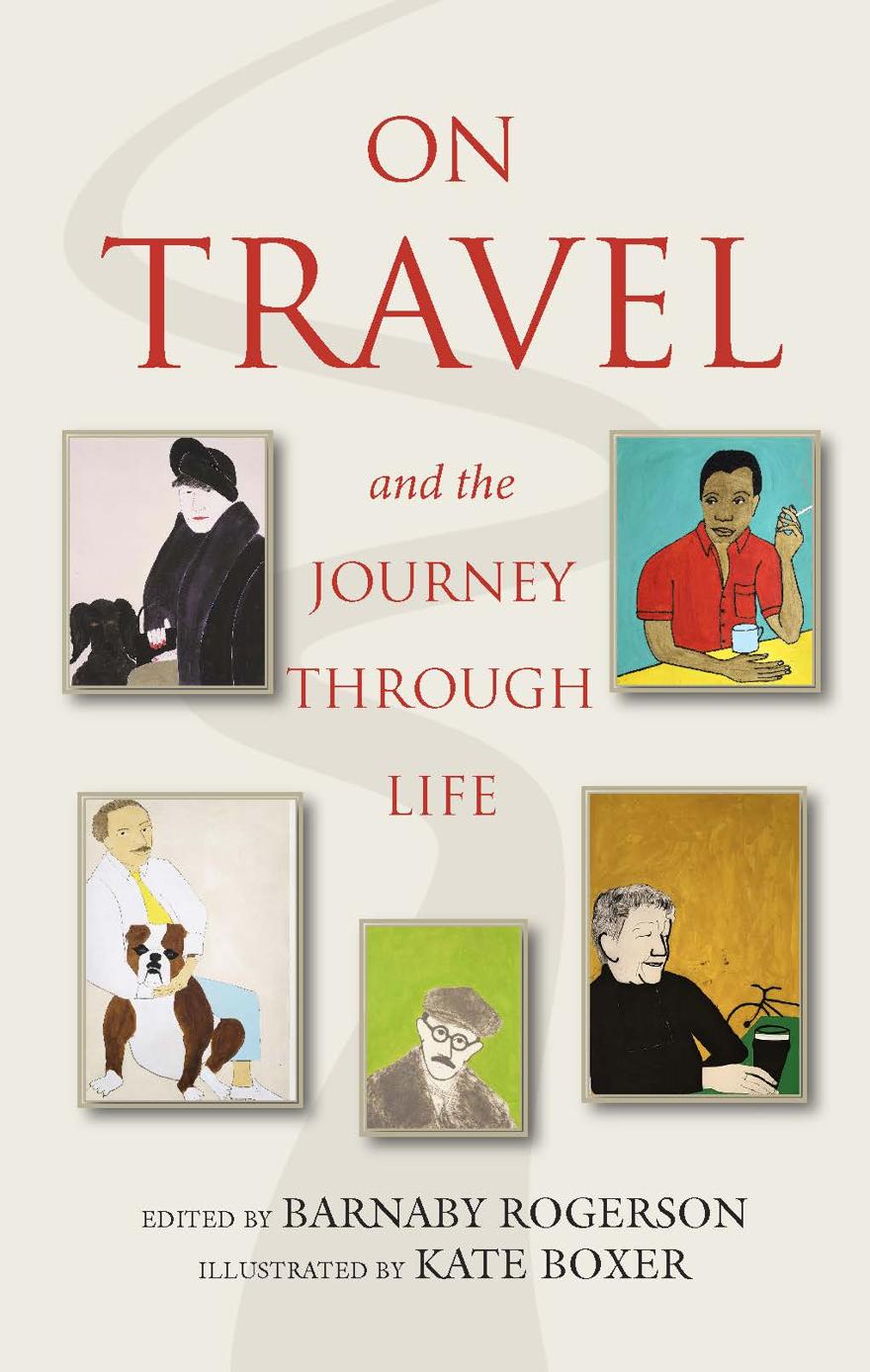
A COMPANION VOLUME · ELAND BOOKS · LONDON · 2022
On Travel and the Journey through Life
edited by Barnaby Rogerson
A commonplace book on travel - 475 quotations from 253 voices, gathered into ten themed chapters by Rogerson and Rose Baring at Eland Books. Mark Twain leads with thirteen entries; Pliny with eleven; Theroux, Murphy, Iyer with eight or nine; Augustine and Wilde with seven each. Each chapter opens to a list of authors; click an author to read their quote(s). Or press ↻ DRAW below for one at random.
SEARCH
Δ. A Book of Travellers’ Tales - Newby’s anthology
Eric Newby - already one of the figures upstairs - had a second great life as the Observer’s Travel Editor and an editor of anthologies. A Book of Travellers’ Tales (Collins, 1985) collects nearly two thousand years of foreign travel writing - from Suetonius Paulinus across the Atlas in ad 61 to V. S. Naipaul in late-twentieth-century Port of Spain - organized by region of the world and then chronologically within each region: a Greek soldier and a Polish journalist share a page when they share a desert. Three hundred and eleven tales across eleven sections (ten geographic regions plus Advice to Travellers - Samuel Johnson, Pückler-Muskau, Galton, Tatchell, et al. on how to travel at all). The chart below is the parlour-voyager’s way in: click any inked region and the anthology unrolls there.
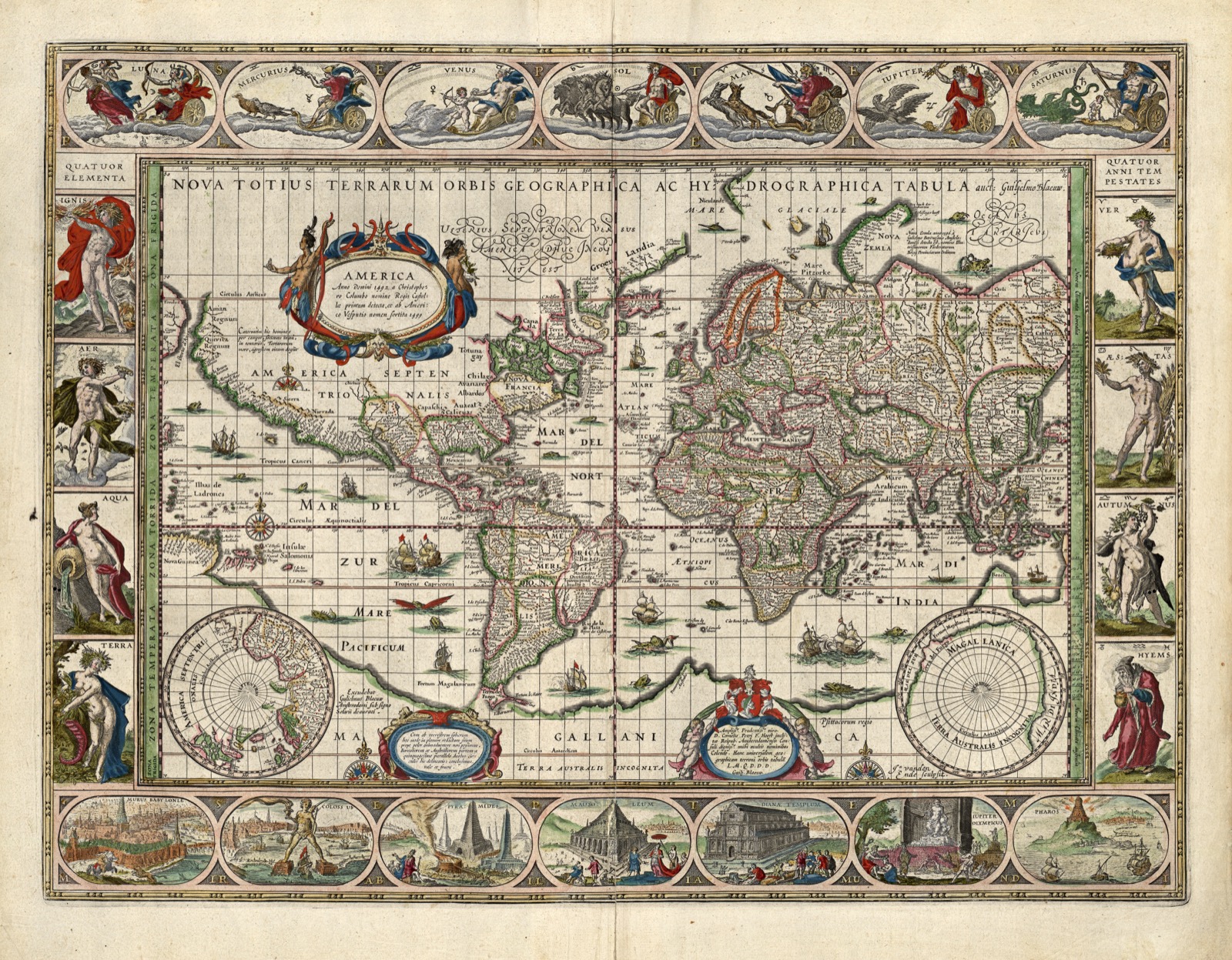
CHART · TEN REGIONS · BLAEU’S 1635 DOUBLE-HEMISPHERE
A Travellers’ Chart of the World
Joan Blaeu’s Nova Totius Terrarum Orbis Tabula, engraved at Amsterdam in 1635 and now in the public domain - the most beautiful world map of the Dutch Golden Age. Newby’s ten geographic regions are pinned over it as clickable hotspots; hover any one to see the tale-count, click to open it in the reader. The eleventh chapter, Advice to Travellers, has no map - open the reader below to read it.
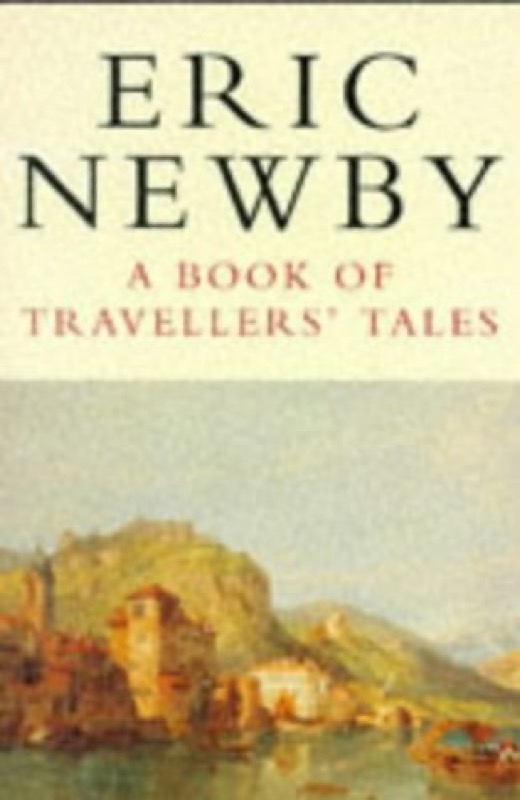
ASSEMBLED BY ERIC NEWBY · COLLINS, 1985 · PICADOR · VINTAGE CLASSICS
A Book of Travellers' Tales
assembled by Eric Newby
Eric Newby - having walked the Hindu Kush, sailed the last grain race, and survived two years in an Italian POW camp - sat at his Observer desk in retirement and assembled this anthology: foreign travel writing from Suetonius Paulinus crossing the Atlas in ad 61 through Bashō, Marco Polo, Ibn Battuta, Captain Cook, Mary Kingsley, Saint-Exupéry, all the way to the late twentieth century. 321 tales from 11 regions. He grouped them by where the writing happened, not when - so a Greek soldier and a Polish journalist share a page when they share a desert. Open a region; the list of authors unrolls. Click an author; their piece unfolds beneath.
SEARCH
Ε. The Tao of Travel - Theroux’s commonplace book
Paul Theroux - already a voice in the gallery above - spent fifty years on the road and forty-odd writing about it. The Tao of Travel: Enlightenments from Lives on the Road (Hamish Hamilton / Penguin, 2010) is his personal commonplace book, assembled in retirement: twenty-seven themed chapters - Travel in Brief, The Pleasures of Railways, The Things They Carried, Travel as an Ordeal, English Travellers on Escaping England, When You’re Strange, Imaginary Journeys, Five Travel Epiphanies - built from passages by the writers who shaped him (Lawrence, Kerouac, Hans Christian Andersen, Nabokov, Madame de Staël, Carson McCullers, Sir Francis Galton) interleaved with his own aphorisms drawn from twelve of his own travel books: The Great Railway Bazaar, The Old Patagonian Express, Dark Star Safari, Ghost Train to the Eastern Star, Pillars of Hercules, Fresh Air Fiend, Happy Isles of Oceania, Kingdom by the Sea, Sunrise with Seamonsters, Riding the Iron Rooster, Sailing Through China, Sir Vidia’s Shadow. Theroux’s own voice is tinted vermilion below so you can see it cut through the centuries of borrowed wisdom.
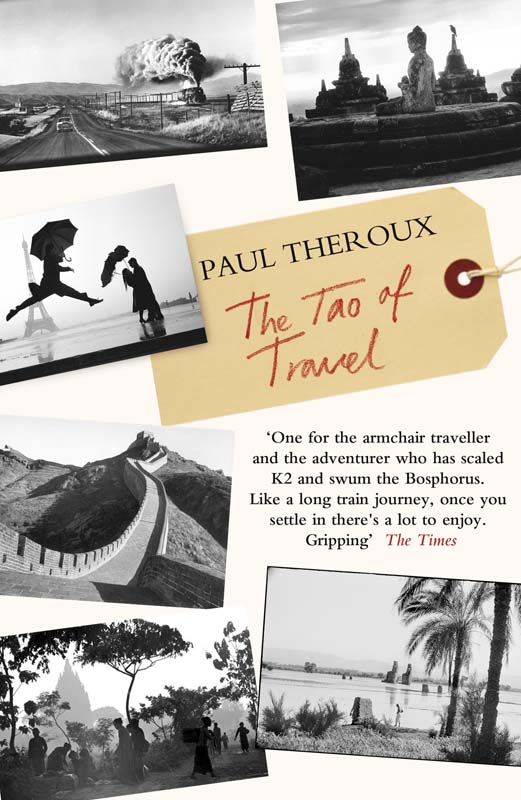
HAMISH HAMILTON · PENGUIN · 2010
The Tao of Travel
Enlightenments from Lives on the Road
Theroux’s personal anthology - 27 chapters · 77k words. Twenty-seven essays in which Theroux weaves 106 quotations from 61 writers who shaped him (Lawrence, Kerouac, Andersen, Nabokov, Doughty, Madame de Staël, Carson McCullers…) through his own connecting prose, with 99 of his own aphorisms drawn from twelve of his travel books appearing as margin notes (vermilion). Pick a chapter on the rail and read.
ΣΤ. Invisible Cities - Calvino’s atlas of dreams
Italo Calvino’s 1972 novel - Le città invisibili - is set in the gardens of Kublai Khan. The old emperor, weary of the empire he can no longer keep in his head, listens to Marco Polo describe fifty-five imaginary cities he claims to have visited. Each city is a short prose meditation. Each belongs to one of eleven themes - Cities & Memory, Cities & Desire, Cities & Signs, Thin Cities, Trading Cities, Cities & Eyes, Cities & Names, Cities & the Dead, Cities & the Sky, Continuous Cities, Hidden Cities. The themes interleave across nine numbered sections. Calvino half-encouraged reading them at random - like a deck of cards - and the panel below does that. Draw a city; an atlas of all fifty-five is beneath, clickable.
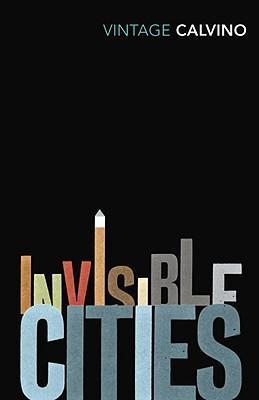
ITALO CALVINO · TRANSLATED BY WILLIAM WEAVER · 1972 / 1974
Invisible Cities
Le città invisibili
Marco Polo describes fifty-five imaginary cities to Kublai Khan, the aging emperor, in his garden at Kai-ping-fu. Each city is a meditation - on memory, desire, signs, names, the dead, the sky. They are organised into eleven themes of five, woven across nine sections, broken by Polo and the Khan’s quiet dialogues. Calvino half-encouraged reading them at random, like turning the pages of a book of hours. The button below does that for you.
Ζ. The Gallery - Sixty-four Dossiers
Each card opens the figure’s full dossier: a short biography, a list of works, and the sayings curated for this archive. The grid below collapses on mobile.
Η. Featured Volumes - the full books
Two of the thirty-seven left a book short enough - and self-contained enough - to read here in full. Both are public-domain. Open either box for the chapter-reader; your place is remembered between visits.
Colophon
The 107 sayings of this archive are taken from books in the public domain (Shackleton’s South, Cherry-Garrard’s Worst Journey, Nansen’s Farthest North, Amundsen’s South Pole, Scott’s Last Expedition, Mawson’s Home of the Blizzard, Slocum’s Sailing Alone, Whymper’s Scrambles, Doughty’s Arabia Deserta, Powell’s Exploration of the Colorado River, Humboldt’s Personal Narrative, Lewis’s Sagittarius Rising, Markham’s West with the Night) plus widely-quoted short aphorisms from later works (Lawrence’s Seven Pillars, Saint-Exupéry, Thesiger, Patrick Leigh Fermor, Herzog, Moitessier, Joe Simpson, Knox-Johnston, Chichester, Anne Morrow Lindbergh). Citations are with each saying.
For deeper reading, the standard companion books are Roland Huntford’s Scott and Amundsen (1979), Caroline Alexander’s The Endurance (1998) for the photographic record, Jeremy Bernstein’s The Wildest Dreams of Kew on Nansen, David Grann’s The Lost City of Z (2009) on Fawcett, Walter Lord’s Peary to the Pole, and Stacy Schiff’s Saint-Exupéry: A Biography (1994). All out of scope for this archive - which is a bedside-companion, not a library.
“There are other Annapurnas in the lives of men.”
- Maurice Herzog, Annapurna (1951), the closing line - written in hospital, no fingers, no toes, after the first eight-thousander.
The 64: ICE - Shackleton · Cherry-Garrard · Nansen · Amundsen · Scott · Mawson · Rasmussen · Wally Herbert · Fiennes. SEA - Slocum · Moitessier · Chichester · Knox-Johnston · Cook · Bligh · Heyerdahl · MacArthur. SAND - Lawrence · Thesiger · Doughty · Leigh Fermor · Bell · Bertram Thomas · Karen Blixen · Robyn Davidson. SKY - Saint-Exupéry · Charles Lindbergh · Markham · Cecil Lewis · Anne Morrow Lindbergh. ROCK - Mallory · Whymper · Herzog · Joe Simpson · Hillary · Tenzing · Messner · Harrer · Buhl · John Muir. RIVER - Powell · Fawcett · Humboldt · Livingstone · Stanley · Mary Kingsley. ROAD - Marco Polo · Ibn Battuta · Bashō · Burton · Stark · Robert Byron · Newby · Theroux · Chatwin · Iyer · Murphy · Bourdain · Jan Morris · Macfarlane · Matthiessen · Kapuściński · Lezhava · Dalrymple.